Maths notation as a language: sets, symbols, and what they mean
A lot of the fear around maths comes from notation: curly letters, upside-down letters, and symbols that look like hieroglyphics. The good news is that maths notation is just a language. Once you learn the vocabulary and grammar—what each symbol means and how phrases are combined—equations stop being cryptic and start saying something clear. In this post I’ll treat notation as language, focus on set notation (the “nouns” of many mathematical statements), and illustrate the main ideas with plots.
1. Equations and notation as language
In any language you have:
- Nouns — the objects you talk about (numbers, sets, vectors, …).
- Verbs / relations — how those objects relate (“equals”, “is in”, “is less than”, …).
- Connectives — how you combine statements (“and”, “or”, “for all”, “there exists”).
Maths does the same, but with symbols so that the same idea is written the same way everywhere. For example:
- $x = 5$ means “$x$ and $5$ are the same number.”
- $x \in A$ means “$x$ is an element of the set $A$” (the verb is “$\in$”: “is in”).
- $A \subseteq B$ means “every element of $A$ is also in $B$” ($A$ is contained in $B$).
So an equation or inequality is just a sentence: it states a relationship between objects. The rest of this post is about one family of “nouns” and “verbs” that show up everywhere: sets and set notation.
2. What is a set?
A set is a collection of distinct objects, thought of as a single thing. We usually denote sets by capital letters ($A$, $B$, $S$, $\mathbb{R}$) and their elements by lower-case letters ($x$, $a$, $3$).
-
Membership — “$x \in A$” means “$x$ is in $A$” (or “$x$ is an element of $A$”).
“$x \notin A$” means “$x$ is not in $A$”. -
Defining a set — We can list elements: $A = {1, 2, 3}$. Or we can describe by a condition:
$A = { x : x \text{ is even} }$
read as “the set of all $x$ such that $x$ is even”. The colon (or sometimes a vertical bar $|$) means “such that”.
So the syntax “${\, \ldots : \ldots }$” is like a sentence: “the set of all [objects] such that [condition].”
3. Subsets and containment
-
$A \subseteq B$ — “$A$ is a subset of $B$”: every element of $A$ is also in $B$. So we can say “if $x \in A$, then $x \in B$”.
-
$A \subset B$ — Some authors use this for “$A$ is a proper subset of $B$” (i.e. $A \subseteq B$ and $A \neq B$). Others use $\subset$ and $\subseteq$ interchangeably; it’s good to check the convention in the text you’re reading.
-
$A = B$ — The sets are equal: they have exactly the same elements (so $A \subseteq B$ and $B \subseteq A$).
So “subset” is the set analogue of “is contained in” or “is part of”.
4. Union, intersection, complement
These are the basic “and / or / not” operations for sets.
-
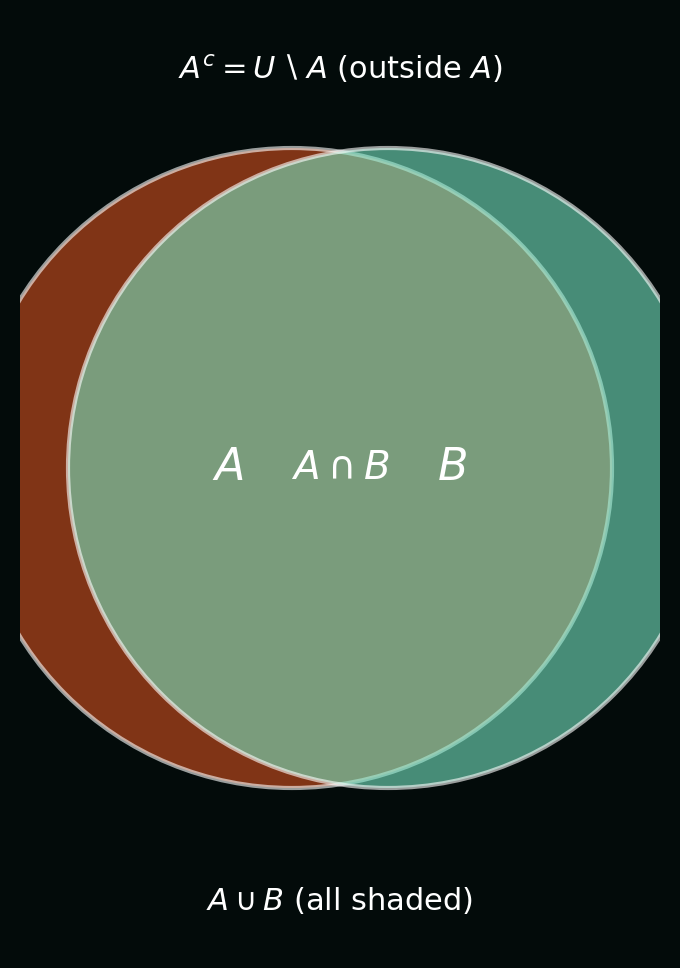
Union — $A \cup B$ is the set of all elements that are in $A$ or in $B$ (or both).
In symbols: $A \cup B = { x : x \in A \;\text{or}\; x \in B }$. -
Intersection — $A \cap B$ is the set of all elements that are in $A$ and in $B$.
$A \cap B = { x : x \in A \;\text{and}\; x \in B }$. -
Complement — If we have a “universe” set $U$ (e.g. all real numbers), then the complement of $A$ in $U$ is
$A^c = U \setminus A = { x \in U : x \notin A }$
i.e. “all things in $U$ that are not in $A$”.
The figure below shows two sets $A$ and $B$ in a universe $U$: $A$ is orange, $B$ is teal; their overlap is $A \cap B$, and the full shaded area is $A \cup B$. The complement of $A$ ($A^c$) is everything in $U$ outside $A$.
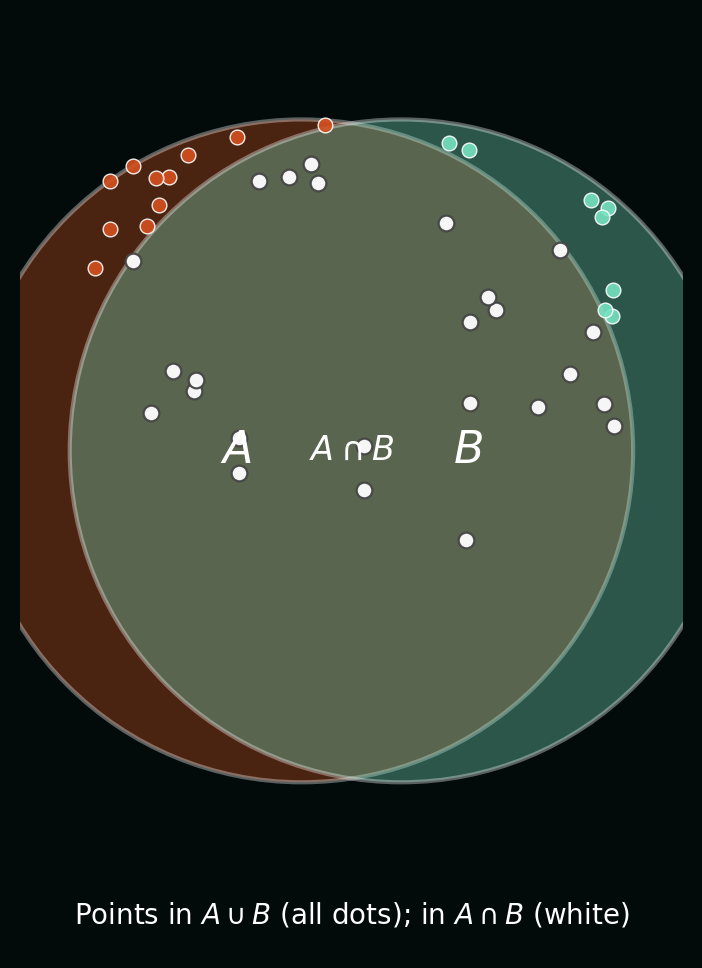
The same idea with datapoints: orange = only in $A$, teal = only in $B$, white = in both ($A \cap B$). Every dot is in $A \cup B$.
So:
- $\cup$ = “or” (union),
- $\cap$ = “and” (intersection),
- $A^c$ or $U \setminus A$ = “not in $A$” (complement).
5. Intervals on the real line
Sets of real numbers are often described by intervals. The notation uses brackets to show whether endpoints are included or not.
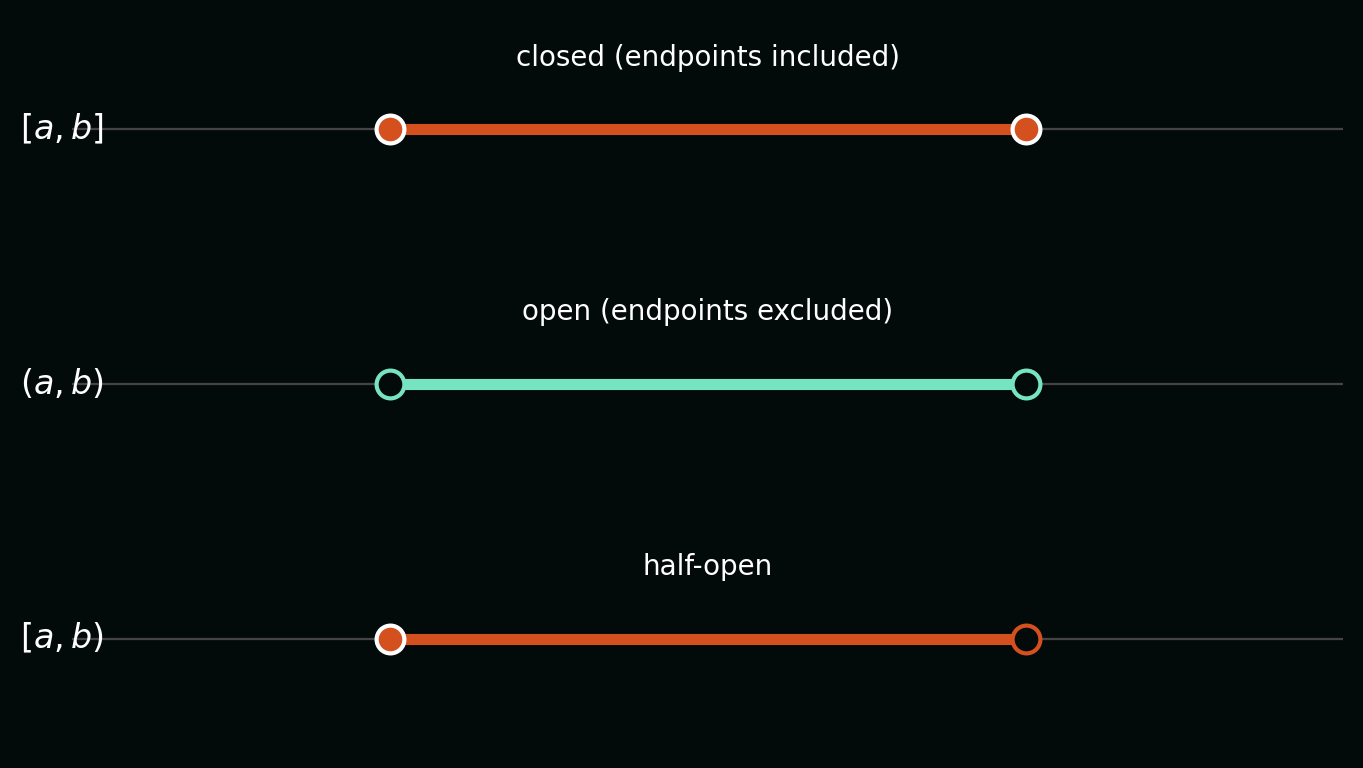
- $[a, b]$ — closed interval: all $x$ with $a \le x \le b$ (endpoints included).
- $(a, b)$ — open interval: all $x$ with $a < x < b$ (endpoints excluded).
Some authors write $]a,b[$ for the same thing. - $[a, b)$ or $(a, b]$ — half-open intervals: one endpoint in, one out.
$[a,b) = { x : a \le x < b }$, and $(a,b] = { x : a < x \le b }$.
So the bracket “$[$” or “$]$” means “include this endpoint”, and the round “$($” or “$)$” means “exclude this endpoint”. That’s the only grammar you need to read interval notation.
The number line below illustrates: filled circles mean “in the set”, open circles mean “not in the set”.
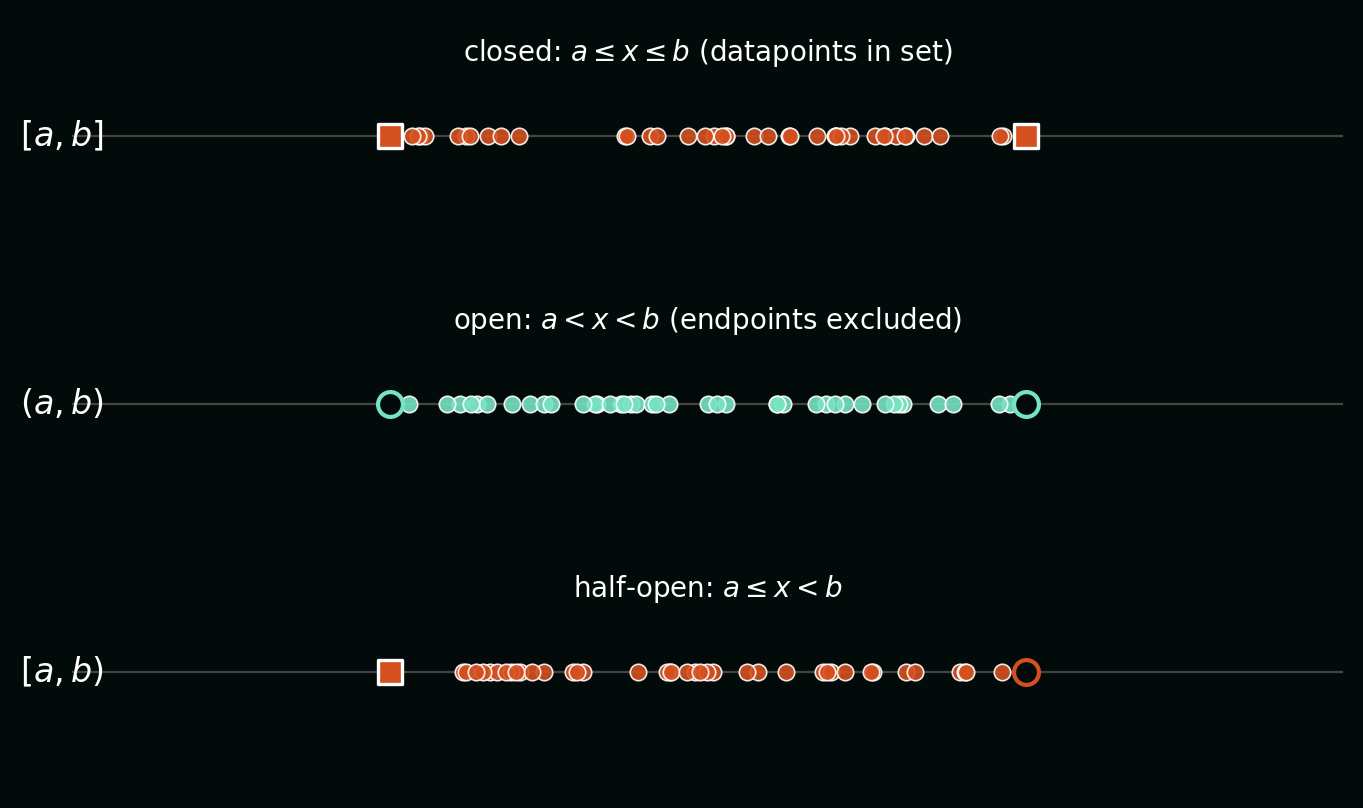
With datapoints: each row shows sample points in the interval. Closed $[a,b]$ includes the endpoints (squares); open $(a,b)$ excludes them (open circles); half-open $[a,b)$ includes $a$ but not $b$.
6. Common number sets
Mathematicians use standard names for familiar sets:
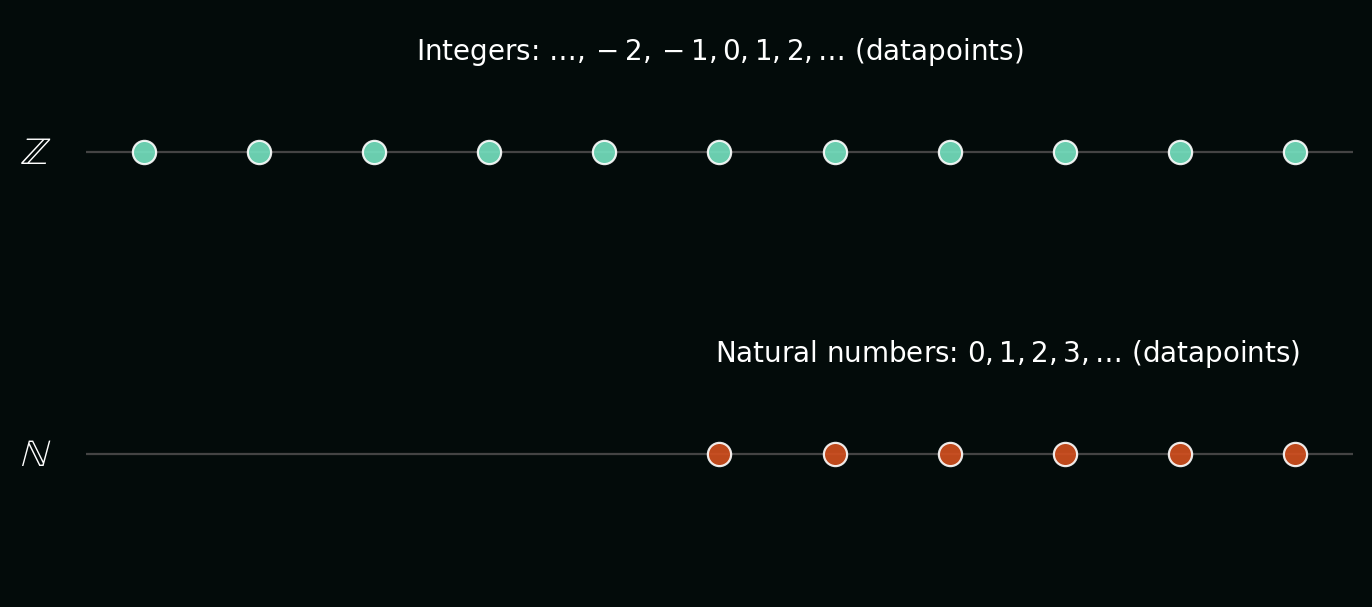
- $\mathbb{N}$ — natural numbers: ${0, 1, 2, 3, \ldots}$ (sometimes people start at $1$; it’s a convention).
- $\mathbb{Z}$ — integers: ${\ldots, -2, -1, 0, 1, 2, \ldots}$.
- $\mathbb{Q}$ — rational numbers (fractions of integers).
- $\mathbb{R}$ — real numbers (the full number line).
- $\mathbb{R}^n$ — set of $n$-tuples of real numbers (e.g. points in $n$-dimensional space).
So when you see “$x \in \mathbb{R}$”, read it as “$x$ is a real number”. When you see “$f \colon \mathbb{R} \to \mathbb{R}$”, read it as “$f$ is a function from the reals to the reals” (domain $\mathbb{R}$, codomain $\mathbb{R}$).
Below, $\mathbb{Z}$ and $\mathbb{N}$ as datapoints on the number line: each dot is one element of the set.
7. Quantifiers: “for all” and “there exists”
Two more “grammar” pieces that turn predicates into statements:
- $\forall$ — “for all”. So “$\forall x \in A,\; P(x)$” means “for every element $x$ in $A$, the statement $P(x)$ holds.”
- $\exists$ — “there exists”. So “$\exists x \in A,\; P(x)$” means “there is at least one $x$ in $A$ such that $P(x)$ holds.”
Example: “$\forall x \in \mathbb{R},\; x^2 \ge 0$” = “for every real number $x$, $x^2$ is at least zero.”
“$\exists x \in \mathbb{R},\; x^2 = 2$” = “there exists a real number $x$ such that $x^2 = 2$.”
So equations and inequalities, combined with $\forall$ and $\exists$, are the sentences of maths: they state what is true for which objects.
8. Putting it together
Maths notation is a language: sets and elements are the objects, symbols like $\in$, $\subseteq$, $\cup$, $\cap$, and $^c$ are the relations and operations, and quantifiers $\forall$ and $\exists$ tie together statements. Once you know what each symbol means and how intervals and set-builder notation work, you can read many definitions and theorems as plain sentences.
- Sets = collections of objects; $\in$ = “is in”; $\subseteq$ = “is contained in”.
- $\cup$ = union (or), $\cap$ = intersection (and), $A^c$ or $U \setminus A$ = complement (not in $A$).
- Intervals = $[\,]$ “include endpoint”, $(\;)$ “exclude endpoint”.
- $\mathbb{N}, \mathbb{Z}, \mathbb{Q}, \mathbb{R}$ = standard number sets.
- $\forall$ = “for all”, $\exists$ = “there exists”.
If you’d like a follow-up, we can do the same “notation as language” treatment for functions ($f \colon A \to B$, $f(x)$, image and preimage) or for logic ($\Rightarrow$, $\Leftrightarrow$, $\neg$). Just ask.