Understanding Oligonucleotide Impurities Across Nucleotide Modifications
Understanding Oligonucleotide Impurities Across Nucleotide Modifications
Oligonucleotide therapeutics represent one of the most rapidly growing classes of pharmaceutical compounds, with over 15 FDA-approved drugs and hundreds more in clinical development [1]. These synthetic nucleic acid sequences, typically 15-30 nucleotides in length, function through mechanisms including antisense oligonucleotides (ASOs), small interfering RNAs (siRNAs), aptamers, and CRISPR guide RNAs. However, the chemical complexity of oligonucleotide synthesis introduces numerous impurities that can significantly impact therapeutic efficacy, safety, and regulatory approval.
Solid-Phase Oligonucleotide Synthesis (SPOS) Cycle
Therapeutic oligonucleotides are synthesized using solid-phase phosphoramidite chemistry, a stepwise process that builds the sequence one nucleotide at a time [1,2]. The following illustrates the four-steps of the solid phase oligonucleotide synthesis (SPOS) cycle:
Solid-Phase Phosphoramidite Synthesis Cycle
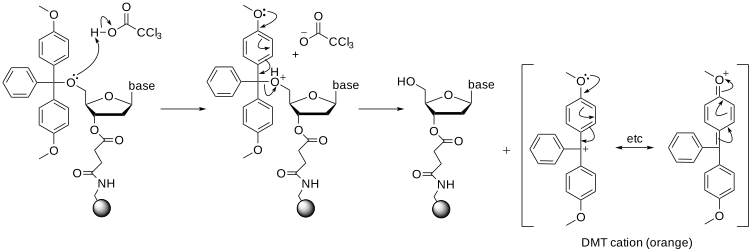
Step 1: Detritylation
The 5'-hydroxyl protecting group (dimethoxytrityl, DMT) is removed using trichloroacetic acid, exposing the 5'-OH for coupling. Incomplete detritylation leads to truncated sequences (n-1, n-2 products).
While the SPOS cycle provides a robust framework for oligonucleotide synthesis, each step introduces multiple opportunities for impurity formation. Incomplete reactions, side reactions, and chemical instability at each stage can lead to a diverse array of impurities that compromise product quality. For instance, incomplete detritylation creates truncated sequences, while incomplete coupling produces deletion products. The acidic conditions used in detritylation can cause depurination, and oxidation steps may introduce backbone modifications. Additionally, the protecting groups themselves can undergo unwanted reactions, and modified nucleotides (MOE, OMe, F, LNA) introduce their own unique impurity pathways. Understanding these potential failure points is crucial for process optimization and quality control in therapeutic oligonucleotide manufacturing.
Nucleotide Modification Families
Therapeutic oligonucleotides incorporate modified nucleotides to enhance stability, binding affinity, and pharmacokinetic properties. The most common modification families include:
Canonical Nucleotides (DNA/RNA)
Standard deoxyribonucleotides (dA, dT, dC, dG) and ribonucleotides (A, U, C, G) form the foundation of oligonucleotide synthesis. Common impurities include depurination (loss of A/G bases), cytosine deamination to uracil, and guanine oxidation to 8-oxo-guanine.
2’-O-Methoxyethyl (MOE)
MOE modifications provide enhanced nuclease resistance and improved binding affinity, commonly used in antisense oligonucleotides. Unique impurity challenges include incomplete MOE deprotection and increased depurination risk during acidic detritylation.
2’-O-Methyl (OMe)
OMe modifications offer moderate nuclease resistance and are widely used in RNA therapeutics. Incomplete methylation can produce 2’-OH contaminants that are nuclease-sensitive.
2’-Fluoro (F)
Fluorine substitution provides excellent nuclease resistance and is common in siRNA therapeutics. Under basic conditions, the C-F bond can be hydrolyzed, converting 2’-F back to 2’-OH.
Locked Nucleic Acid (LNA)
LNA nucleotides feature a 2’-O,4’-C methylene bridge, creating a rigid conformation that significantly enhances binding affinity. The bicyclic structure introduces ring strain, making LNA more susceptible to ring-opening under harsh conditions.
Common Impurity Classes
Given the complexity of the synthesis cycle and the multiple reactive steps involved, impurities in oligonucleotide synthesis arise from several sources:
-
Incomplete Deprotection: Failure to fully remove protecting groups (e.g., N6-dimethylamino on adenine, N4-acetyl on cytosine) leaves blocked positions that prevent proper base pairing.
- Nucleobase Modifications:
- Oxidation: Guanine forms 8-oxo-guanine, which pairs with adenine instead of cytosine
- Deamination: Cytosine deaminates to uracil under acidic conditions, creating C→U mutations
- Depurination: Acidic conditions cause loss of purine bases (A, G), creating abasic sites
-
Truncated Sequences: Incomplete coupling reactions produce shorter sequences (n-1, n-2, etc.), typically the most abundant impurities. Regulatory limits typically require n-1 <2-5%.
-
Deletion Products: Missing nucleotides in the sequence, more severe than truncation as the sequence structure is disrupted. Typically must be <1% for therapeutic applications.
- Backbone Modifications: For phosphorothioate oligonucleotides, incomplete sulfurization creates mixed phosphate/phosphorothioate backbones, altering nuclease resistance.
Interactive Impurity Exploration
Use the interactive visualization below to explore impurities across different nucleotide families:
Select Nucleotide Family:
Select Nucleotide:
Select a family and nucleotide to view impurities
Implications for Manufacturing
Understanding impurity profiles is essential for process optimization, quality control, and regulatory compliance. Analytical methods including HPLC, mass spectrometry, and capillary electrophoresis are used to identify and quantify impurities. Regulatory agencies typically require full-length product >85-90%, n-1 <2-5%, and individual impurities <0.1-1% for therapeutic applications [4,5].
References
-
Padroni, G., et al. (2025). The Potential of Machine Learning in Oligonucleotide Therapeutics Manufacturing. ChemRxiv. doi:10.26434/chemrxiv-2025-qb9rz. This content is a preprint and has not been peer-reviewed.
-
Beaucage, S. L., & Caruthers, M. H. (1981). Deoxynucleoside phosphoramidites - a new class of key intermediates for deoxypolynucleotide synthesis. Tetrahedron Letters, 22(20), 1859-1862. https://doi.org/10.1016/S0040-4039(01)90461-7
-
Roberts, T. C., et al. (2020). Advances in oligonucleotide drug delivery. Nature Reviews Drug Discovery, 19(10), 673-694. https://doi.org/10.1038/s41573-020-0075-7
-
ICH Harmonised Tripartite Guideline (2006). Impurities in New Drug Substances Q3A(R2). International Council for Harmonisation of Technical Requirements for Pharmaceuticals for Human Use.
-
Gilar, M., et al. (2011). Study of phosphorothioate-modified oligonucleotide resistance to nuclease activity using ion-pair reversed-phase high-performance liquid chromatography. Analytical Chemistry, 83(13), 5327-5333. https://doi.org/10.1021/ac200748s
This blog post is designed for educational and research purposes. For therapeutic applications, consult current regulatory guidelines and analytical data specific to your synthesis conditions.