Front cover in Science Advances: linker histone H1 as a liquid-like glue for chromatin
I am very happy to share that our new paper is out in Science Advances and featured on the front cover. The paper is Shimazoe et al. (2026), “Linker histone H1 functions as a liquid-like glue to organize chromatin in living human cells” (10.1126/sciadv.aec9801).
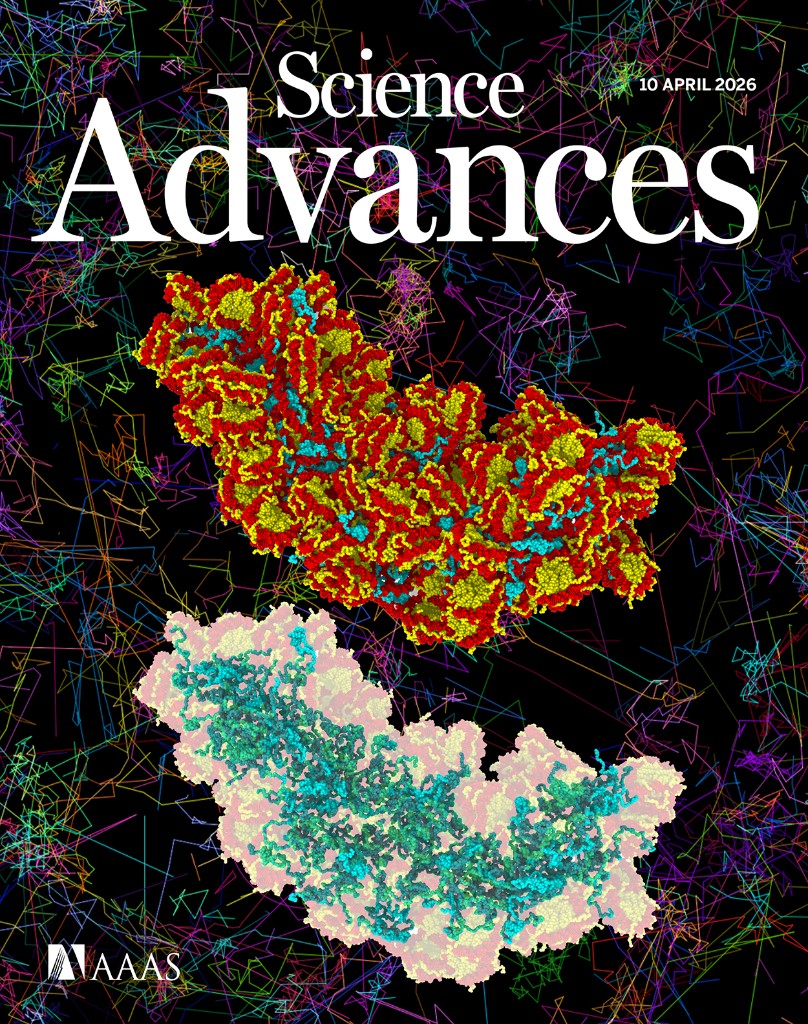
At the center of this work is a long-standing question in genome biology: how can chromatin stay compact inside the nucleus while still being accessible enough for transcription, replication, and repair? The traditional picture emphasizes relatively stable binding of linker histone H1 at the nucleosome dyad. But increasingly, live-cell studies suggest that chromatin in cells is not a rigid architecture. It is irregular, dynamic, and fluid-like.
This project is especially personal for me because the computational modeling in the paper is deeply rooted in my PhD work. Seeing those ideas mature into a mechanistic framework that now appears on the front cover of Science Advances genuinely feels surreal. It is one of those rare moments where years of simulation development, validation, debugging, and cross-talk with experiments suddenly crystallize into a clear biological story.
1. The biological problem we wanted to resolve
Linker histone H1 is one of the most abundant chromatin proteins in eukaryotic cells, and we know from decades of genetics and cell biology that it matters for genome organization, development, and disease. At the same time, a purely static model of H1 has always felt incomplete: if chromatin were compacted only through rigid locking interactions, it would be hard to reconcile that with the speed and flexibility required for DNA-templated processes in living cells.
So the core question became: Can H1 compact chromatin in a way that is physically dynamic rather than structurally frozen?
Our findings support a clear answer. In living human cells, most H1 molecules do not behave as static clamps. They behave in a liquid-like way, dynamically exchanging contacts and transiently interacting with multiple nucleosomes. In practical terms, H1 can promote compaction while preserving mobility.
2. Experimental strategy in living cells
A central part of the paper is direct single-molecule measurement in native chromatin context. We introduced HaloTag into endogenous H1.2 using CRISPR editing and tracked individual molecules in live RPE-1 cells using sparse labeling and oblique illumination microscopy. This setup allowed us to follow H1 motion at high temporal resolution and compare it directly with nucleosome behavior measured in matched conditions.
Trajectory analysis was then performed using vbSPT (a hidden Markov model framework), which separated H1 motion into distinct dynamic states. The key result was that the majority population is liquid-like, with a smaller bound fraction and a minor transiently dissociated state. We also tested mitotic chromosomes and found that, even in this highly condensed context, H1 retains dominant liquid-like behavior. That was an important confirmation that the mechanism is not restricted to one cell-cycle state.
To determine where this liquid-like population moves, we combined H1 tracking with dual-color super-resolution imaging of nucleosome-defined domains (PALM + single-molecule tracking). Liquid-like H1 trajectories were enriched in denser chromatin regions. In other words, the signal is not just “H1 diffuses somewhere in the nucleus”; it is specifically tied to chromatin domain architecture.
3. Computational modeling: the mechanistic backbone
The modeling side of this paper came directly out of the multiscale chromatin framework I developed and used during my PhD, so this part means a lot to me personally. We used chemically specific coarse-grained molecular dynamics, where histones are represented at amino-acid resolution and DNA is represented with sequence-aware coarse graining and explicit electrostatics.
Rather than forcing H1 into one fixed binding geometry, the simulations allowed H1 to bind and unbind dynamically. This was crucial. Across systems ranging from nucleosome arrays to larger nucleosome clusters, H1 consistently formed weak, multivalent, transient contacts and frequently engaged multiple nucleosomes over time. Mechanistically, this produced compaction without rigid ordering, exactly matching the “condensed but dynamic” behavior suggested by live-cell imaging.
A particularly strong moment in the project was seeing convergence between simulation and experiment on the same qualitative mechanism: H1 is neither fully free nor mostly immobile; it is predominantly a dynamic cross-linker operating inside chromatin domains.
4. Perturbation and causality
To move from description to mechanism, we used rapid H1.2 depletion with an auxin-inducible degron system and quantified changes in chromatin domain organization with super-resolution analysis. Acute H1.2 loss decondensed chromatin domains in cells. Independent in silico reduction of H1 produced the same directional behavior in the modeled chromatin systems.
This cross-validation matters because it closes the loop: the same component that appears dynamically “glue-like” in measurements is also required for maintaining compaction when perturbed.
5. What I think is genuinely new here
For me, the novelty is not only in measuring H1 dynamics directly, but in connecting scales in a quantitatively coherent way: single molecules in live cells, domain-level super-resolution context, and physics-based multiscale models that explain why those dynamics produce compaction.
The resulting picture is that H1 functions as a liquid-like glue: a dynamic electrostatic mediator that cross-links nucleosomal DNA transiently and multivalently. That framework helps explain how chromatin can remain compact yet accessible, and why a rigid textbook-only view of H1 is likely incomplete in living cells.
6. A personal note
Because the computational component grew from my PhD, this paper feels like a full-circle moment. So much of PhD research is incremental and uncertain: building models, validating assumptions, troubleshooting force fields and sampling, and trying to ensure that simulation outputs are biologically interpretable. To see that line of work integrated with beautiful live-cell experiments and then featured on the cover of Science Advances is honestly hard to process. I am deeply grateful to all collaborators who made this possible.
If you would like to read the full study, including figures, supplementary data, and computational details, you can find it here: Science Advances article page.