My Research
Choose a topic to open a fullscreen view — scroll through the animation and into the findings.
Scroll to explore
Computational biophysics · PhD research
H1 linker histone mobility in bulk chromatin
How linker histone H1 compacts chromatin while remaining dynamic — multiscale simulations from my PhD, validated in living cells.
The liquid-like glue model
The classical view places the H1 globular domain stably at the nucleosomal DNA dyad, stabilising a twisted zig-zag 30-nm fibre. Our work supports a different picture: at physiological salt, H1 acts as a liquid-like glue — dynamically exchanging contacts and forming weak, multivalent, transient interactions with nucleosomal and linker DNA across many nucleosomes.
This does not contradict zig-zag conformations observed by cryo-EM. Rather, H1 mobility allows chromatin to remain compact yet fluid and accessible, screening electrostatic repulsion between DNA linkers while preserving the irregular, dynamic domain organisation seen in living cells.
Computational modelling
Simulations used a chemically specific coarse-grained chromatin model (one bead per amino acid, sequence-aware DNA with explicit electrostatics) in LAMMPS. H1.2 was free to bind and unbind dynamically — not fixed to the dyad — across systems from single nucleosomes and 12-mer arrays (195 bp NRL) to a 108-nucleosome cluster (one H1.2 per nucleosome).
Region-specific contact maps show the globular domain preferentially contacts the side region of nucleosomal DNA, not the dyad. A single H1.2 bridges multiple nucleosomes simultaneously; contact histograms span dozens of nucleosomes per molecule. HaloTag inclusion on the H1 C-terminus alters binding profiles only marginally, supporting its use as an experimental probe.
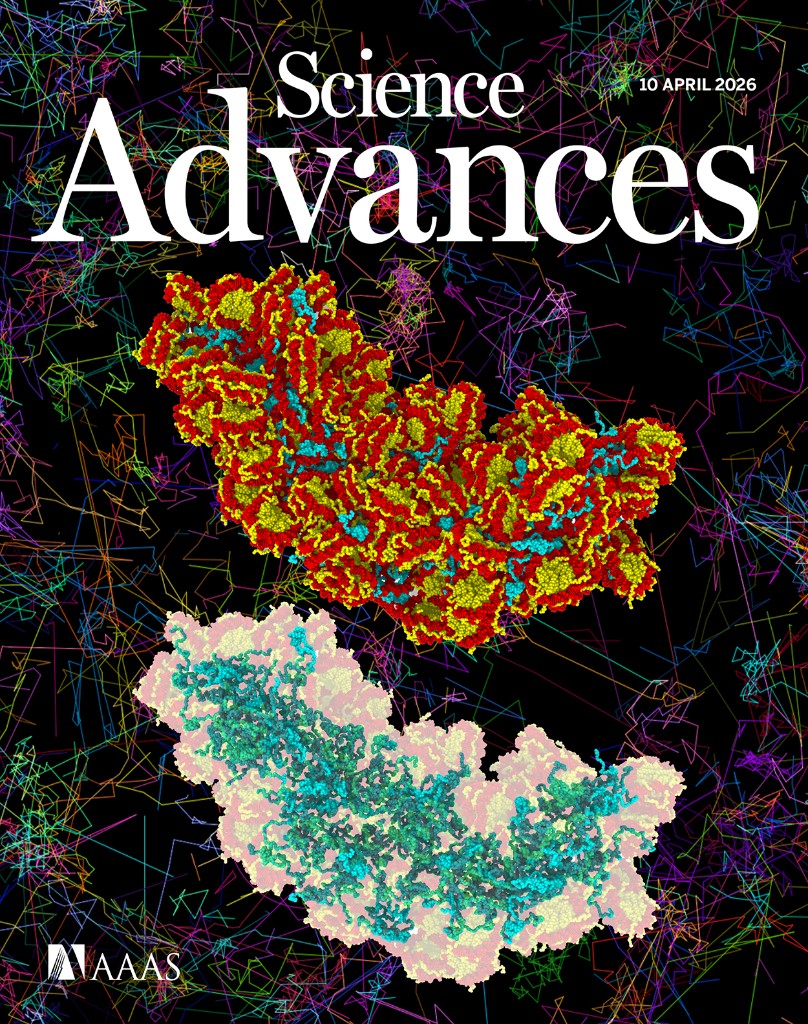
In the 108-nucleosome domain, H1.2 diffuses throughout the cluster forming transient multivalent cross-links. Reducing H1.2 by 75% (emulating solvent washing) produced immediate decompaction and a marked drop in sedimentation coefficient — paralleling the live-cell depletion experiments.
Building the 108-nucleosome system (PhD methodology)
Simulating H1 mobility in dense chromatin required moving beyond linear starting conformations, which would take prohibitive time to collapse. I built the 108-nucleosome fibre from an equilibrated 12-nucleosome, 195 bp NRL template taken from temperature-replica-exchange MD:
- Gradual pulling on terminal linker DNA to expose joining segments.
- Replication and rotation of the 12-mer using transformation matrices (see thesis appendix).
- Harmonic joining of nine segments into a 108-nucleosome fibre, with uniquely coloured histones per segment to track H1 movement.
The simulation ran for 295 million timesteps (20 fs, 300 K) — ~5.9 μs of physical time — probing H1 behaviour in a highly condensed environment analogous to compact cellular chromatin.
Bulk chromatin results (PhD)
Compaction. Chromatin compaction increased over the simulation and plateaued at a sedimentation coefficient of ~180 S, from an initial state of nine equilibrated 12-nucleosome segments joined together.
H1 intermixing. Removing core histones and DNA from the final structure reveals extensive H1.2 intermixing — linker histones originally associated with one segment contact nucleosomes far beyond their starting neighbourhood. Quantitatively, each H1.2 globular domain interacts with the DNA of ~30 other nucleosomes on average (including linker DNA), with some molecules contacting 20+ and highly mobile molecules exceeding 50 segments.
Domain preferences. H1.2 favours the side DNA region over the dyad throughout the simulation. A contact heat map across the nine initial segments shows a homogeneous H1 distribution: each 12-nucleosome segment retains at least 12 H1.2 molecules at all times, with middle segments accumulating more H1 in a compaction-dependent manner.
Relative mobility. Mean square displacement analysis shows H1.2 is substantially more mobile than nucleosomes (~3× greater MSD on average), with implications for chromatin structural flexibility and gene regulation.
Reduced H1 concentration. Selectively removing 75% of H1.2 (retaining one H1 per four nucleosomes) triggered immediate chromatin expansion, increased DNA exposure, and decreased sedimentation coefficient. H1.2 remained highly mobile (~20 DNA segments contacted per molecule) with diverse interaction profiles. Both nucleosome and H1 MSD decreased relative to the saturated system — consistent with reduced electrostatic screening when H1 is scarce, while H1 still favours side-DNA contacts and can form small clusters during decompaction.
Broader context from my thesis
Across my PhD I used this multiscale framework to probe how nucleosome repeat length, salt, sliding/breathing, H1 CTD phosphorylation, HMGA1, and halotag labelling reshape chromatin. Saturated H1.2/HMGA1 simulations on dual 5-nucleosome fibres showed transient binding (most H1 bound <30% of simulation time) with a maximum capacity of ~40 H1 per fibre. Hyperphosphorylated HMGA1 increases H1 residence time, suggesting a role in chromatin stabilisation during cell-cycle transitions.
Together with experimental collaborators, these results support H1 as a regulated, dynamic cross-linker — not a static clamp — whose liquid-like glue activity condenses chromatin domains while keeping them accessible for transcription, replication, and repair.
Science Advances (2026)
Single-molecule imaging of endogenous H1.2–HaloTag in live RPE-1 cells (oblique illumination, 50 ms frames) combined with vbSPT trajectory classification revealed three dynamic states: bound, liquid-like, and transiently dissociated. The majority population (~60% interphase; ~58–70% across conditions and H1 variants) is liquid-like, with MSD growing almost linearly in time — consistent with diffusive motion inside chromatin rather than immobile dyad anchoring.
Dual-colour PALM of nucleosomes (H2B–PAmCherry) overlaid with liquid-like H1 trajectories showed enrichment in denser chromatin domains. The same liquid-like behaviour persists in mitotic chromosomes (~500–700 nm structures), where ~70% of H1 is liquid-like. H1.2 MSD exceeds nucleosome MSD in matched conditions, echoing decades of FRAP studies but now resolved at single-molecule resolution.
Rapid H1.2 depletion via auxin-inducible degron in HCT116 cells (effective within ~3 hours) decondensed chromatin domains measured by nucleosome PALM and L(r) analysis — establishing that the dynamically glue-like H1 population is required to maintain compaction.
Read the full study: Shimazoe et al., Science Advances (2026) · My write-up →
Applied machine learning
ML Systems & Pipelines
Building production-grade ML infrastructure for scientific R&D — from pilot datasets to deployed models on customer platforms.
Platform extensions
Extensions to Alchemite™ and integrations across vendor LIMS, ELN, and custom cloud infrastructure.
Preprocessing & automation
Reusable preprocessing and modelling templates so teams move from exploratory data to production workflows faster.
Bayesian optimisation
Experimental design and multi-objective optimisation for formulation and process development.